

A swimwear tech pack is the single production-ready document that tells a factory exactly how to make your swimsuit, covering technical flats, the bill of materials, fabric specs, graded measurements and construction notes. Get it right and you cut sampling rounds and stop the endless email chain of factory questions before it starts. Get it wrong and you pay for both, in time and in fabric.
TL;DR:
- A comprehensive swimwear tech pack should include detailed technical flats, precise fabric and elastic specs, and a clear grading and measurement tolerance to prevent factory assumptions.
- Testing fabric recovery and stretch properties before finalising elastic and grading details minimizes costly rework and ensures the fit maintains shape after multiple washes.
- Custom materials and trims, with specific supplier references and artwork files, are essential for accurate costing and print placement, especially when using unique prints or trims.
- Lead times for custom swimwear generally range from 40 to 75 days, with higher minimum order quantities and design complexity increasing production duration and costs.
- Platforms like Wovaai can generate structured, factory-ready tech packs from sketches, reducing sampling rounds and streamlining communication, especially for small brands with limited technical resources.
Table of Contents
- The essential swimwear tech pack checklist
- How do you build a swimwear tech pack from sketch to factory?
- Swimwear-specific technical specs: fabrics, linings, elastics and seams
- Measurements, grading and tolerance best practice
- Bill of materials, trims and artwork: practical guidance
- What manufacturers expect: lead times, MOQs and cost drivers
- How Wovaai helps brands produce manufacture-ready swimwear tech packs
- The part of tech pack advice nobody wants to hear
- Get your swimwear tech pack production-ready faster with Wovaai
- Sources
- FAQ
The essential swimwear tech pack checklist
Most rejected samples trace back to one missing detail in the original file, not a factory error. Run through this list before anything goes to a manufacturer.
- Cover page: style name, season, SKU, designer contact and a version number so nobody works from an outdated file.
- Technical flats: front, back and any internal views, fully annotated with seam lines, strap widths and clasp placement.
- Bill of materials (BOM): outer fabric, lining, elastics, trims, thread type, foam pads and labels, each with a supplier reference.
- Fabric specifications: fibre composition, GSM, stretch direction and recovery percentage, plus which supplier tests back those figures.
- Measurements and grading: a full points-of-measure list with tolerances for every graded size.
- Construction notes: seam types, stitch lengths and exactly where elastic gets applied and at what tension.
- Colourways and prints: Pantone references or digital art files with placement guides for every panel.
- Packaging and labelling: fold method, poly bag type, hangtag position and care label wording.
- Version control: a sign-off log showing who approved which revision and when.
A complete swimsuit tech pack reduces sampling time and production errors precisely because it removes the guesswork on all nine points above. Miss one, and a factory will fill the gap with its own assumption, which is rarely the one you wanted.
How do you build a swimwear tech pack from sketch to factory?
Building the file in the right order saves you from redrawing flats after the fabric test comes back wrong. Work through these steps for each style before it leaves your desk:
- Lock the silhouette and size range first, so every later spec measures against a fixed base.
- Draw clean technical flats, labelling internal views separately from external ones so nobody confuses a lining panel for an outer layer.
- Assemble the BOM and order fabric tests for stretch, recovery, chlorine resistance and UV fade before you commit to a supplier.
- Write construction call-outs and map elastic placement, noting the tension percentage at each point, not just the width.
- Build the measurement spec with grading rules, including a tolerance box on every point of measure.
- Prepare artwork files with scale references and placement guides, then finalise packaging and labelling instructions.
- Run a pre-submission checklist and stamp the file with a version number before it goes out.
Pro Tip: Send your fabric for stretch and recovery testing before you finalise the elastic map. A fabric that recovers at 85% needs a different tension setting than one that recovers at 95%, and finding that out after cutting starts is an expensive lesson.
Technical flats need to show seam lines, strap shapes, clasp placement and binding widths clearly enough that a factory can't misread the design intent. That single habit prevents more rework than any other line item in this list.
Swimwear-specific technical specs: fabrics, linings, elastics and seams
Swimwear fabric behaves differently from almost anything else you'll spec, and generic apparel tech pack templates rarely account for that. A few details matter more here than in dry garment production.
- Fabric composition and stretch type: state the fibre blend, GSM and whether the fabric is 4-way or 2-way stretch, since that changes pattern grading entirely.
- Recovery rate: record the percentage and ask the supplier for lab test results rather than relying on a swatch feel.
- Lining strategy: decide between full front lining, partial support panels or power mesh, and list the exact fabric for each, since factories commonly build full front lining into many swim styles as standard.
- Elastic specification: note the type, width, placement and tension for every application point, not just "elastic at leg opening".
- Seam and stitch selection: call out overlock for seam allowance control, coverstitch for flat, stretch-friendly finishes, and bonded seams where you want a seamless look without stitch holes.
Polyester/elastane blends generally hold colour and resist chlorine better than nylon/elastane, which is why factories lean towards polyester blends for training swimwear where repeated pool exposure matters more than hand-feel. Resort and fashion swimwear can afford the softer nylon blend because it isn't fighting daily chlorine damage.
Measurements, grading and tolerance best practice
Points of measure for swimwear differ from ready-to-wear because so much of the fit depends on stretch, not just cut. The core list includes bust circumference, underbust, waist, hip, front rise, back rise, leg opening, strap length and gusset width, each measured flat and unstretched unless the spec states otherwise.
- State the tolerance range on every measurement, typically ±0.5cm for smaller points like strap width and ±1cm for larger ones like hip circumference.
- Present tolerances as a dedicated column in the spec sheet, not a footnote, so graders see them alongside each measurement.
- Grade in consistent increments across the size run, usually 2 to 4cm per jump depending on your target market's sizing standard.
- Fit-test across at least three sample sizes, not just the sample size, since stretch fabric can distort grading assumptions that work fine on woven garments.
Bill of materials, trims and artwork: practical guidance
A vague BOM is where most costing arguments start. Every line needs enough detail that a factory can quote without guessing.
- List composition, supplier and colour code for every material, and include unit cost if you already have supplier quotes.
- Reference trims by supplier code, not just a description, and note colourway matches and hygiene liner requirements for bottoms.
- Specify artwork file types, scale percentage and repeat size for prints, and mark match points where a print crosses multiple panels.
Getting this section right does more for your quote accuracy than any other page in the pack, since factories price almost entirely off the BOM and artwork specs.
What manufacturers expect: lead times, MOQs and cost drivers
Factories will tell you fast if your expectations don't match their production reality, so it helps to know the ranges before you ask.
- MOQs for stock patterns and fabrics often sit lower than custom work, while fully custom patterns and fabrics typically start around 300 to 500 pieces per colourway.
- Sampling through bulk production commonly totals roughly 40 to 75 days depending on how much customisation the style needs.
- Cost drivers stack in a predictable order: fabric choice first, then print complexity, trim count, order quantity and any custom tooling for unique hardware.
MOQs and timelines in the moderate unit range and several-week production periods are typical for custom swimwear, though stock-fabric programmes can move faster and cheaper. Budget for the custom range if your design uses a print or trim nobody else is already running.
How Wovaai helps brands produce manufacture-ready swimwear tech packs
Some platforms generate production-ready tech packs from design inputs, mapping onto the checklist above: technical flats, BOM, fabric specs, graded measurements and construction notes all in one structured file rather than scattered across sketches and spreadsheets. These solutions aim to close the gap between what a designer means and what a factory reads, using AI to draft the annotated flats and specification pages that usually take the most design time.
For small brands without an in-house technical designer, using such a platform can translate into fewer sample rounds and cleaner factory handoffs, since the file arrives structured as manufacturers expect it. The practical payoff is time: less spent redrawing flats after a factory misreads a seam line, and less spent on email threads chasing down a missing fabric spec.

The part of tech pack advice nobody wants to hear
Most tech pack guides treat swimwear like any other garment category with a different silhouette, and that's the mistake. Stretch behaviour, chlorine exposure and lining strategy aren't footnotes here. They're the difference between a suit that holds its shape after twenty pool sessions and one that sags by the fifth wash.
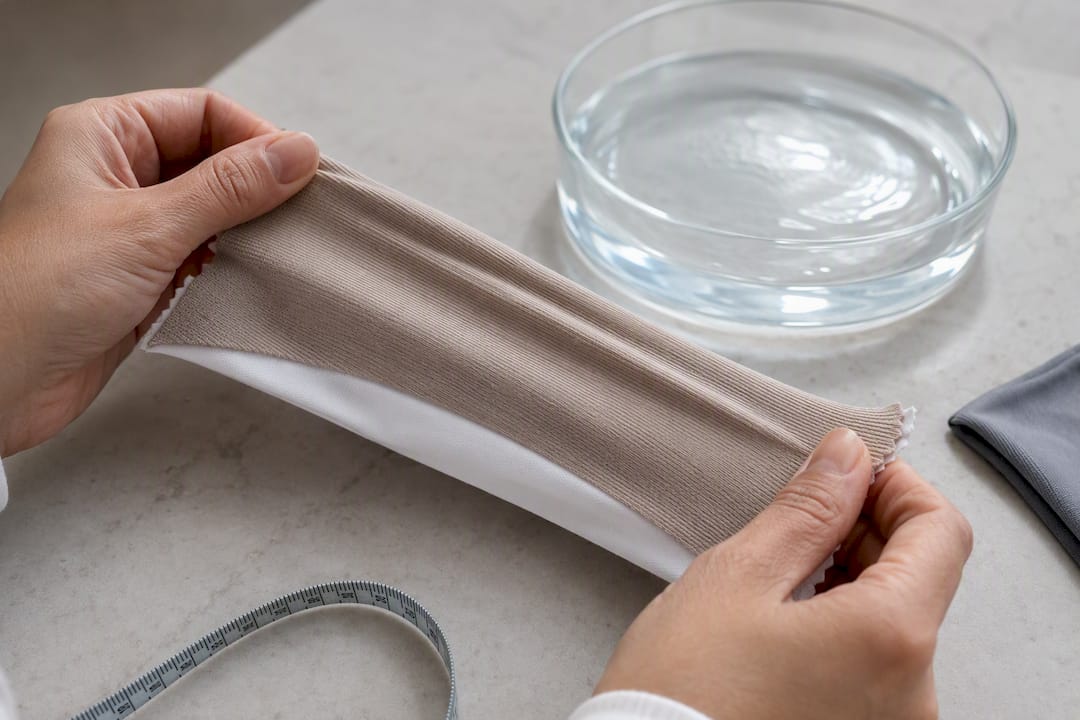
The conventional advice, buy a generic template, fill in the blanks, underrates how much swimwear-specific detail actually changes the outcome. An elastic map without tension notes is decoration, not a specification. A fabric line without a recovery percentage is a guess dressed up as data. Factories can work around vague specs, but they'll fill the gaps with whatever's cheapest or fastest for them, not what you intended.
If you take one thing from this guide, prioritise the fabric testing and elastic mapping before you touch grading or packaging. Everything else in the pack can be corrected on a second sample. A poor recovery rate baked into your pattern grading often can't be, not without redoing the fit from scratch.
— Mohamad
Get your swimwear tech pack production-ready faster with Wovaai
Some platforms turn design inputs into manufacture-ready tech packs faster than building one by hand, without needing a technical designer on staff. Whereas freelance pattern houses charge per revision and generic templates leave swimwear-specific gaps like elastic tension and recovery rates, these platforms generate flats, BOM, fabric specs and graded measurements as one structured file built for how factories read them.

That matters most for small brands launching their first swim collection, where every sample round costs real money and every factory query costs time you don't have. If your last tech pack came back from the factory with three pages of clarifying questions, that's the exact problem Wovaai is built to remove before the file ever leaves your desk. Start a trial at Wovaai and generate your first production-ready swimwear tech pack from your existing sketches and specs.
Sources
- Designer swimsuits: from sketch to production guide — Arcus Apparel Group
- Swimwear OEM guide: fabric, fit & production — YOUMEGA
- How to make a swimsuit tech pack — Senvyn
FAQ
What should a swimwear tech pack include?
A complete tech pack needs technical flats, a bill of materials, fabric specifications with stretch and recovery data, a graded size chart with tolerances, construction notes, colourway references and packaging and labelling instructions.
How much should a swimwear tech pack cost?
Costs vary widely depending on whether you hire a freelance technical designer, buy a template, or use a platform like Wovaai, but the real cost comparison is the time and sample rounds saved rather than the upfront fee alone.
Are tech suits legal in competitive swimming?
Governing bodies like FINA (now World Aquatics) regulate technical racing suits through fabric and construction rules that change by competition level, so always check current governing-body regulations rather than assuming a suit is compliant based on past rules.
What is a pubikini?
A pubikini is a style of bikini bottom cut low enough to sit below the pubic line, and if you're specifying one, the tech pack needs unusually precise front rise and gusset measurements with tight tolerances given how little margin the style allows.
How long does swimwear production typically take?
Sampling, pattern development and bulk production together often total roughly 40 to 75 days depending on customisation, though stock-fabric programmes with lower MOQs can move faster than fully custom builds.