
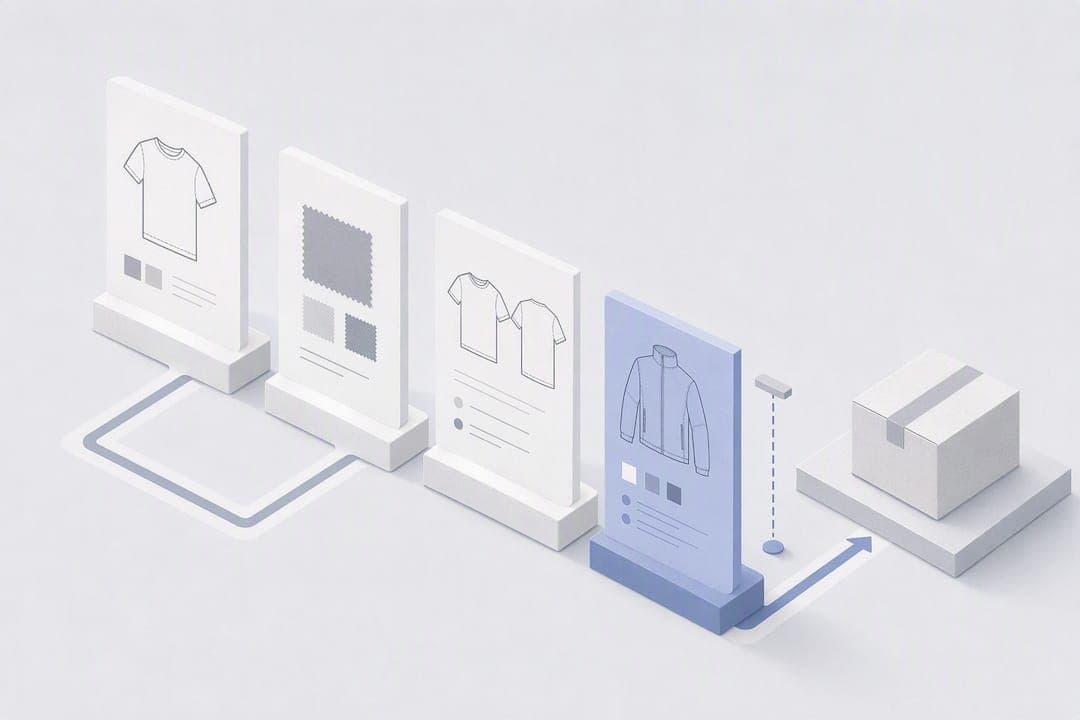
An AI tech pack generates an editable first draft, complete with flats, a measurement table and a preliminary bill of materials, in minutes rather than hours. It's a genuine head start, not a finished document. Before anything goes to a factory, a technical designer still needs to verify tolerances, grade rules and construction notes by hand.
TL;DR:
- AI tech packs can generate a useful first draft in minutes from photos, sketches, or briefs, but still require manual verification and adjustment.
- The draft usually includes flats, measurement points, a bill of materials, and rough construction notes, all based on pattern recognition.
- Human input is essential for specifying stitch types, grading across sizes, and supplier-specific details that AI cannot predict.
- A factory-ready tech pack must include complete measurement sheets, BOM, construction notes, revision history, and consistent data formatting.
- Verification involves measuring samples against AI points, confirming tolerances, and updating BOM and notes before dissemination.
Table of Contents
- What is an AI tech pack and how does the generation process work?
- What can't AI reliably get right in a tech pack?
- What must a factory-ready tech pack include?
- How do you turn an AI draft into a factory-ready pack?
- Does an AI tech pack actually save time and money?
- Why trust this approach to AI tech packs?
- How do AI tech packs fit into PLM and ERP systems?
- What software do designers actually use to build AI tech packs?
- How do you keep AI-generated tech pack data accurate?
- Where has AI tech pack generation worked in real production settings?
- How should studios actually roll this out?
- Try Wovaai for your next tech pack
- Sources
- FAQ
What is an AI tech pack and how does the generation process work?
Most AI tech pack tools follow a similar pipeline. You feed the system an input, it interprets that input against a library of garment templates, and it returns a structured draft you can edit.
The inputs that work best are flat-lay photos of a sample, a rough sketch, a CSV of rough measurements, or a short written brief describing silhouette and fabrication. Some platforms accept a combination of all four, which tends to produce a more accurate first pass than a single photo alone.
What comes back typically includes:
- Auto-drawn technical flats, front and back, sometimes with side and detail views
- Suggested points of measure (POMs) mapped to a standard size
- A draft bill of materials listing fabric type, likely trims and estimated quantities
- Rough construction notes describing seam type and closures, based on visual pattern recognition
Image analysis works by matching visual features (a collar shape, a pocket placement, a topstitch line) to spec fields in a template library, then populating those fields with a best guess. Industry practice notes that this kind of AI-generated draft is genuinely useful as a starting point, but it still needs checking against a physical sample and against a standardised measurement system before anyone treats it as final. Export formats generally cover editable PDF, Excel spec sheets, and vector flats in SVG format, so you can hand the file to a pattern maker or drop it straight into a PLM system.
What can't AI reliably get right in a tech pack?
AI is strong at pattern recognition and weak at judgement calls that depend on fit history, supplier relationships, or fabric behaviour under tension. Three areas consistently need a human pass:
- Seam and stitch specification. An AI draft might note "topstitch" without specifying the ISO 4915 stitch class a factory actually needs to quote correctly.
- Grade rules across the size range. AI can suggest a base size's measurements, but grading increments between sizes usually require a technical designer's input, especially for brands with a distinct fit philosophy.
- Supplier-specific trim codes and fabric references. An AI tool has no way of knowing your zip supplier's part number or that your knit mill runs 4% shrinkage on a particular yarn blend.
The fix is a short verification pass: measure a physical sample against every point of measure in the draft, confirm tolerances (usually ±0.25cm to ±1cm depending on the measurement and garment type), and translate any vague construction note into a specific stitch class or seam finish. Standardised measurement naming and clearly stated tolerances are what stop a factory from guessing.
Pro Tip: Keep a simple changelog inside the tech pack itself, a one-line note per revision (v1.2: adjusted hem POM from 68cm to 69cm after first sample). It saves enormous back-and-forth on round two.
What must a factory-ready tech pack include?
A factory doesn't need a beautiful document. It needs every field filled in, because factories check measurement charts, BOM entries and construction callouts the moment a pack lands in their inbox, and gaps mean guesswork or delay. A complete pack, AI-assisted or otherwise, runs through these sheets:
- Cover page. Style ID, version number, date, and the base size the spec sheet is built around.
- Technical flats. Front, back, and any detail views, drawn to a consistent scale with callouts pointing to stitching, hardware and trim placement.
- Spec sheet. Every point of measure named consistently, a base value for each, a tolerance range, and grade rules showing how that measurement changes across the size run.
- Bill of materials. Fabric composition and weight, trims, thread type and colour, hardware, Pantone references and supplier notes for every component, because a missing thread spec alone can stall a sample.
- Construction and packaging notes. Seam types, closures, folding and bagging instructions, plus artwork placement for any print or embroidery.
- Revision history. A running log of what changed between versions and why.
A tech pack functions as the single source of truth for the entire production run. Miss a sheet, and you've handed the factory permission to make an assumption on your behalf.
How do you turn an AI draft into a factory-ready pack?
The workflow that actually saves time follows a fixed order. Skip a step and you'll likely pay for it in a second or third sample round.
- Prepare clean inputs. Photograph your prototype flat, with a ruler in frame if possible, and write a two or three sentence brief covering fabrication and fit intent.
- Generate the draft. Run the inputs through your AI tech pack tool and export the editable flats along with a spec CSV, not just a flattened PDF.
- Run a first-pass QA. Walk through every POM against the physical sample, confirm the grade rules make sense for your size range, and fill any BOM gaps the AI left blank or guessed at.
- Version and export. Save the corrected file as a versioned, single multi-page PDF named with style number and version, and keep the editable source file for the next revision.
- Send with a feedback window. Issue the pack to your factory with a clear request, first-fit sample by a specific date, and a defined channel for questions.
That fourth step matters more than it looks. A clear revision history and version numbers on every page stop a factory from accidentally sampling against an outdated draft, which is one of the more common and entirely avoidable causes of a wasted sample.
Does an AI tech pack actually save time and money?
The time saving is the most obvious win: a first-draft tech pack that used to take three or four hours to draw and populate manually can come back from an AI tool in minutes, leaving you with editing time instead of drafting time. Editable, standardised templates paired with AI generation produce the fastest route to a document a factory will actually accept.
Beyond speed, a complete BOM from the outset makes supplier quoting far more accurate, since costing depends entirely on knowing every fabric, trim and hardware line before you ask for a price. The best-fit cases are collections with repeated silhouettes, styles you reorder each season, and high-turn SKUs where a fast, clean draft across ten or twenty styles beats hand-drafting each one from scratch.
Why trust this approach to AI tech packs?
Some AI tools are built specifically for manufacture-ready tech pack generation, with design choices focused on what a factory needs to see rather than producing a pretty PDF. That distinction shapes everything from field naming to export structure.
The operational controls that matter for accuracy sit underneath the AI draft: editable flats you can correct without redrawing from scratch, version tracking so nobody samples against an outdated file, a BOM you can complete line by line, and export into factory-ready formats a pattern maker or production manager can open immediately. None of that replaces a technical designer's sign off.
How do AI tech packs fit into PLM and ERP systems?
Most mid-sized and larger brands already run a Product Lifecycle Management (PLM) system to manage styles, seasons and vendor data, and an Enterprise Resource Planning (ERP) system to handle purchase orders, inventory and costing. An AI tech pack tool needs to slot into that stack rather than sit beside it as an island.
The practical integration point is the export format. A tech pack generated as an editable spec CSV and vector flats can be imported into most PLM platforms' style records, updating BOM fields and measurement charts without manual retyping. That matters because manual re-entry is where transcription errors creep in, a trim quantity mistyped between systems is a classic cause of an incorrect purchase order.
For brands without a full PLM system, a well-versioned PDF plus an editable Excel spec sheet often does the job just as well at smaller scale. The BOM data from an AI-generated pack, once verified, can feed directly into an ERP costing sheet, since fabric consumption, trim counts and thread type are exactly the fields a costing calculation needs. The key requirement either way is consistent field naming across your tech pack template and your PLM or ERP schema, so a "chest width" in one system doesn't become an unmatched blank field in another.
What software do designers actually use to build AI tech packs?
The tools in this space fall into a few broad categories rather than one standard product. Dedicated AI tech pack generators take photos, sketches or briefs and return editable flats and spec drafts, aimed specifically at designers who need a fast first pass without opening a pattern-making application. General-purpose design software with AI plug-ins sits at the other end, useful if your studio already has an established workflow in a vector or CAD tool and wants AI assistance layered on top rather than a separate platform.
A third category covers PLM platforms that have added AI drafting features to their existing style management modules, which suits larger teams who want tech pack generation to live inside the same system that already tracks their seasons and vendors.
Whichever category you're evaluating, the features worth testing are the same: does it export editable vector flats rather than flattened images, does it let you set tolerances and grade rules rather than just a single base measurement, and does it produce a BOM structure you can actually complete rather than a static image of one. A tool that only outputs a nicely rendered flat with no editable spec fields underneath isn't really a tech pack generator, it's an illustration tool with extra steps.
How do you keep AI-generated tech pack data accurate?
Accuracy problems in AI-generated packs almost always trace back to weak inputs, not a weak model. A blurry photo, an unmeasured prototype, or a one-line brief with no fabrication detail gives the AI too little to work with, and it fills the gaps with plausible-sounding guesses.
Three habits fix most of that. First, photograph or scan a physical, already-measured sample wherever possible rather than a sketch, since the AI has real proportions to reference instead of an artist's interpretation. Second, standardise your measurement naming before you generate anything, using the same point-of-measure labels across every style so grading and comparison stay consistent season to season. Standardised naming, stated tolerances and grade rules are precisely what separate a pack a factory can quote confidently from one that generates a list of clarifying questions.
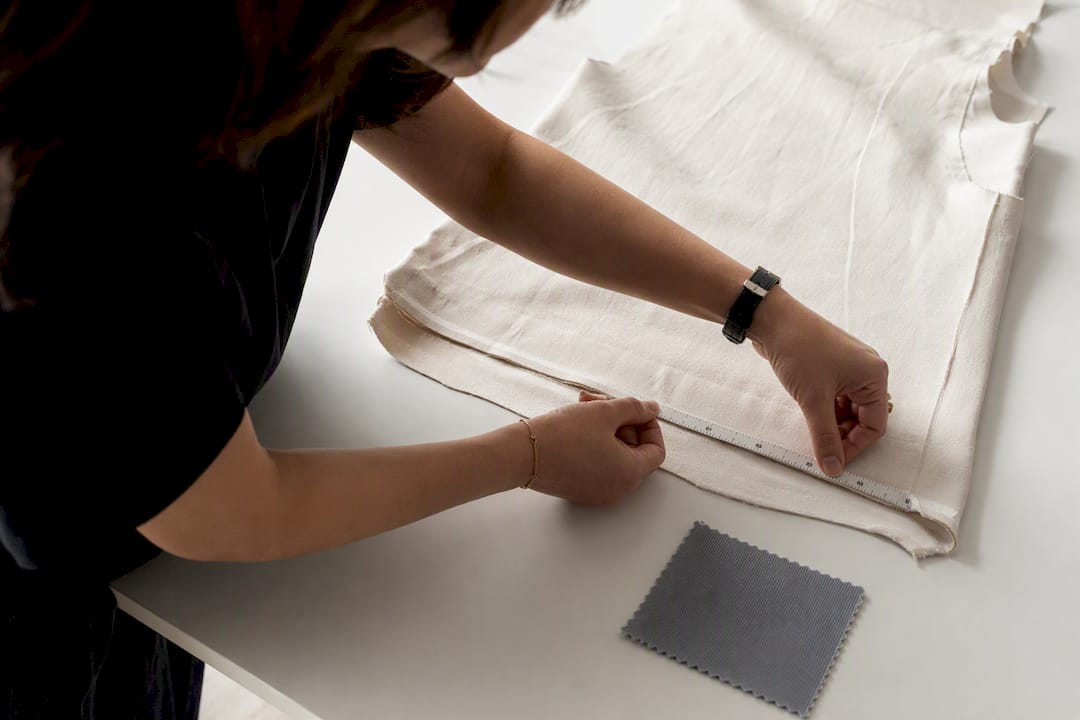
Third, build a verification checklist you run every single time, not just when something feels off. Check every POM against a tape measure, confirm the BOM has a supplier note and Pantone reference for each material, and read every construction note aloud to check it actually specifies something a machinist could act on. Treat the AI draft as a hypothesis about the garment, not a finished statement of fact, and the accuracy problem mostly resolves itself.
Where has AI tech pack generation worked in real production settings?
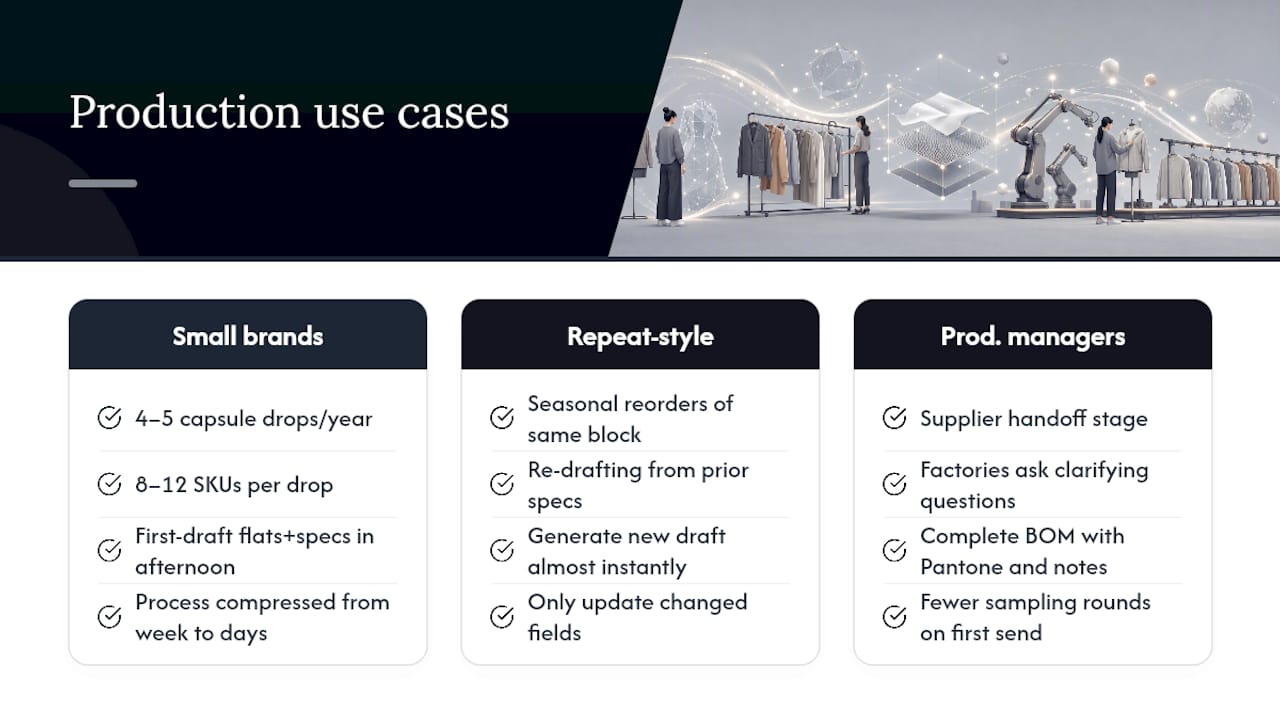
Small brands running frequent drops are the clearest use case so far. A studio releasing four or five capsule collections a year, each with eight to twelve SKUs, faces a drafting bottleneck that has nothing to do with design talent and everything to do with hours in the day. Generating first-draft flats and specs across a dozen styles in an afternoon, then spending the following two days on verification and correction, compresses a process that used to eat most of a working week.
Repeat-style businesses see a different benefit. A brand that reorders the same core hoodie or trouser block each season, with only fabric or colour changes, can generate a new draft from the previous season's photos and measurements almost instantly, then update only the fields that actually changed. That's a meaningfully different task from drafting a new garment from nothing.
Production managers handling supplier handoff report the clearest quality signal: a complete BOM with Pantone references and supplier notes filled in before the pack ever reaches the factory floor. When that happens on the first send, sampling rounds tend to drop because the factory isn't stopping to ask basic clarifying questions it shouldn't need to ask. The pattern across these cases isn't that AI replaces technical drafting, it's that it removes the blank-page problem and leaves the technical designer with editing work instead of origination work.
How should studios actually roll this out?
Pilot AI tech packs on one product category first, not your whole line at once, and enforce version discipline from day one, since a messy rollout with no revision log creates more confusion than the manual process it replaced. Treat the AI output as a drafting accelerant, never a substitute for a technical designer's sign off on tolerances and construction. Keep editable source files for every style and a clear revision log, because that habit is what actually protects you two seasons from now.
— Mohamad
Try Wovaai for your next tech pack
An AI-powered tool can turn a photo, sketch or brief into an editable, manufacture-ready tech pack in minutes instead of the hours a manual draft usually takes, which matters most when running several styles through development at once rather than one.
If you're weighing up whether an AI-generated draft can actually hold up against a factory's scrutiny, the fastest way to find out is to test the specific features that matter for accuracy: editable flats you can correct without redrawing, spec export into formats your pattern maker already uses, a BOM you can complete line by line with Pantone and supplier references, and version controls that keep every revision traceable. Run one real style through the Wovaai demo and check the output against a sample you've already measured. That single test tells you more than any feature list, and you can start it from the Wovaai landing page today.
Sources
- How To Create A Tech Pack To Send To Manufacturers - Shopify
- How to Make a Tech Pack for Clothing (2026) - TechDraw AI
- How To Create A Tech Pack For Clothing Brands (Factory-Ready Guide) - SiGraphics
FAQ
What is an AI tech pack?
An AI tech pack is a production specification document, flats, measurements, BOM and construction notes, generated automatically from a photo, sketch or brief, which a technical designer then reviews and completes before sending it to a factory.
Can AI replace a technical designer entirely?
No. AI reliably drafts flats, POM suggestions and a preliminary BOM, but grade rules, exact stitch specifications and supplier-specific trim codes still need a technical designer's verification.
What file formats do AI-generated tech packs export to?
Most tools export editable PDF, Excel spec sheets and vector flats in SVG format, which allows pattern makers and factories to work directly with the file rather than a flattened image.
How does an AI tech pack reduce sampling errors?
By starting from a complete draft with standardised measurement names, tolerances and a filled BOM, factories have fewer gaps to guess at, which is what reduces sampling errors compared with an image-heavy or incomplete pack.
Does Wovaai generate manufacture-ready tech packs?
Some AI platforms generate editable, manufacture-ready tech packs from images and briefs, including flats, BOM fields, and version-controlled export formats designed for factory handoff.