
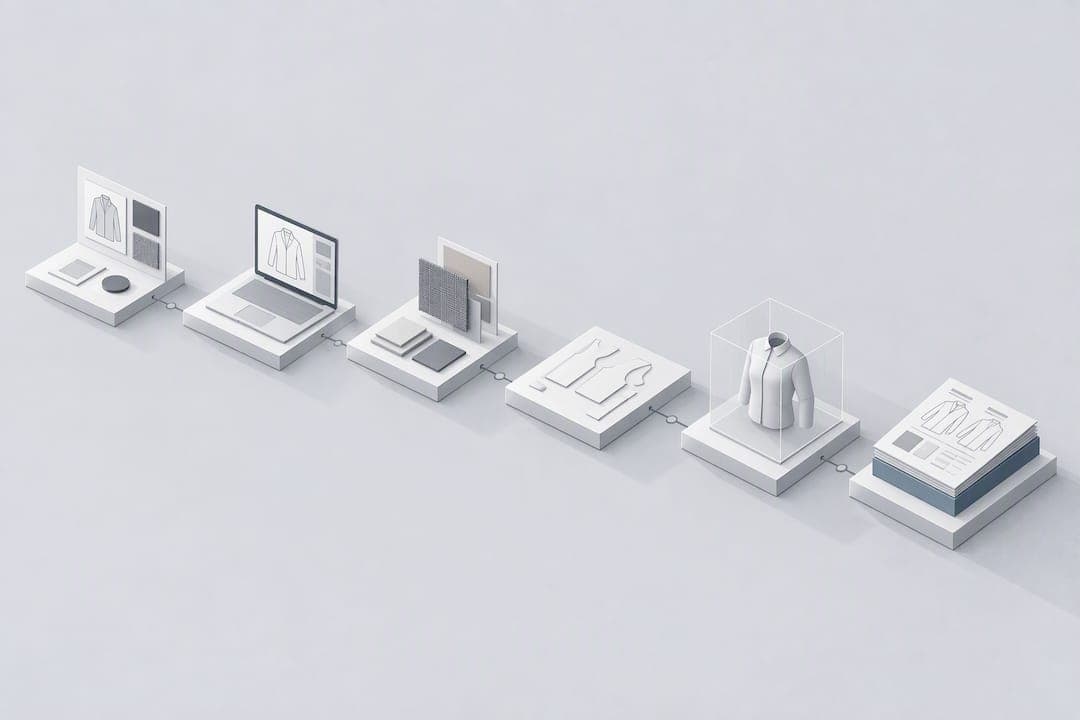
AI fashion design now turns a text prompt or rough sketch into finished visual concepts and a first-draft tech pack within minutes, not weeks. It genuinely accelerates ideation, visualisation and early production paperwork. It does not replace the technical eye that checks seam allowances, grading and drape before anything reaches a factory floor. Platforms such as WOVA are built precisely for that idea-to-tech-pack journey, but the human check remains non-negotiable.
TL;DR:
- AI-driven fashion design tools can generate initial concepts, flats, and tech packs within minutes, but human expertise remains crucial for validation.
- Pattern extraction and technical drafting are progressing rapidly but still require manual checks for seam allowances, grainlines, and fit suitability before production.
- Legal ownership depends on documenting human contribution, and prompts should avoid proprietary brand details to mitigate trademark risks.
- Future developments aim toward agentic AI that orchestrates the entire product development process with better traceability, but current systems primarily assist, not replace, designers.
- Small-scale pilots with clear success metrics and a focus on file compatibility should guide adoption, as human review is mandatory at every stage.
Table of Contents
- What AI can actually do in fashion design today
- Practical workflows: from idea to production-ready files
- Why photorealism isn't the same as manufacturability
- Copyright, trademark and ownership issues
- Where the models are heading next
- How designers should adopt AI: a practical checklist
- WOVA: supporting the designer to factory journey
- Bias, sustainability and the ethics of AI-generated fashion
- Popular AI tools and platforms shaping fashion design
- Case studies: how fashion brands are putting AI to work
- The real limits of AI in creative fashion work
- Where AI genuinely helps, and where designers must stay in control
- Try WOVA for your next collection
- Sources
- FAQ
What AI can actually do in fashion design today
The gap between marketing demos and daily studio reality is smaller than it was two years ago, but it still exists. Text-to-image generation now produces coherent, on-brand garment concepts from a paragraph of description, and sketch-to-render tools convert a flat pencil drawing into a photorealistic mockup showing drape, texture and colourway variations. Inpainting lets you swap a sleeve, recolour a print, or test a different collar without redrawing the whole garment.
Where things get genuinely useful for commercial teams is the output range:
- Virtual photoshoots and model generation — replacing or supplementing physical shoots for e-commerce, cutting turnaround for seasonal drops.
- Text-to-image concepting — generating dozens of directional options from one brief in the time it takes to brew coffee.
- Sketch-to-render — turning technical flats into presentation-ready visuals for buyers and stakeholders.
- Automated pattern-module extraction — early-stage tech-pack drafting that identifies construction pieces from a flat sketch.
The visual layer is the most mature. Pattern extraction and tech-pack drafting are advancing fast, according to a systematic review of 163 publications, but they still need a trained eye before anyone cuts fabric.
Practical workflows: from idea to production-ready files
A working AI-assisted pipeline looks less like magic and more like a structured relay between machine speed and human judgement. Most studios that have adopted it follow a similar sequence:
- Prompt or sketch input — describe the garment in a few sentences or upload a rough sketch as the starting point.
- Iterate on visual direction — generate variations, recolour, and adjust silhouette until the concept locks.
- Generate flats and pattern modules — the system breaks the visual into technical flats and proposes construction pieces.
- Assemble the tech pack — measurements, fabric specifications, construction notes and trims get compiled into a document a factory can read.
- Run a virtual fit review — check proportions and drape digitally before committing to a physical sample.
- Human technical validation — a pattern cutter or technical designer checks seam allowances, ease and grading logic.
Pattern modules matter because factories don't work from pretty pictures. They need CAD-compatible files with grainlines, notches and seam allowances defined, which is exactly the layer that separates a nice concept from a workable spec. Sector studies on AI visualisation tools in pre-production report perceived reductions in sample costs and faster collection cycles when these steps are properly integrated with existing production workflows, rather than bolted on as a separate creative exercise.
Pro Tip: Run your first AI-generated tech pack past a sample maker before you commit to a full production order, even if the file looks complete. Catching a grading error on paper costs nothing; catching it after cutting fifty units costs a lot.
Why photorealism isn't the same as manufacturability
A stunning render tells you almost nothing about whether a garment can actually be sewn. Seam allowances, grainlines and the way fabric drapes under gravity are structural facts that a purely visual model has no reason to get right unless it was specifically trained on construction logic rather than pixels.
This is where the research gets genuinely encouraging, with caveats attached. An AI-based flat-sketch-to-pattern system achieved an mAP50 of 0.849 for identifying and combining pattern modules, a strong result for automated construction-piece detection. A separate multimodal deep-learning framework reported an IoU of 0.93 and an average landmark alignment error of 3.2 pixels under experimental evaluation, showing tight geometric correspondence with reference patterns.
Those numbers describe controlled experimental conditions, not a guarantee that every AI-generated pattern will grade cleanly across a full size run. Before anything moves to production, run these checks:
- Verify grainline direction against the fabric's actual stretch and weave.
- Confirm seam allowances are present and consistent across all pieces.
- Check notch placement aligns pieces correctly during assembly.
- Have a pattern cutter grade the sample size across your full size curve.
- Sew a physical toile before cutting your production fabric.
Practitioner analysis backs this up directly: modular pattern mapping, not pixel-only generation, is what makes automated pattern work industrially feasible. Skip the pattern cutter at your own cost.
Copyright, trademark and ownership issues
Generative models learn from vast image datasets, and plenty of that training data is in-copyright fashion photography and illustration. That raises a live legal question: does a design generated from a prompt trained on copyrighted work carry any of that liability forward? Legal analysis of the issue recommends documenting the human contribution to any AI-assisted design as the clearest way to support an ownership claim.
Trademark risk is the more immediate danger for most brands. Ask a generative model for "a quilted handbag with a chain strap" and it may drift uncomfortably close to a recognisable luxury silhouette, purely because that imagery dominates its training data. Steer prompts deliberately away from named brands or their signature details.
Practical safeguards worth building into your process from day one:
- Keep prompt logs and timestamped records of every significant edit.
- Save intermediate files showing your manual modifications, not just the final render.
- Note contributor names against each major change.
- License stock or reference assets properly rather than scraping them.
Treating the AI as a drafting tool, with a documented trail of human decisions layered on top, is the strongest position a designer can take if ownership is ever questioned.
Where the models are heading next
The technical foundation underneath AI fashion design has shifted meaningfully in a short space of time. A systematic literature review of 163 publications documents a clear move from GAN-based systems to diffusion models and large language model integration, with diffusion and LoRA adaptations now the dominant path for controllable, high-fidelity generation.
The next layer is agentic AI, systems that don't just generate an image but orchestrate tasks across the product development pipeline. Lectra's launch of Apogy is an early example, embedding agentic AI to coordinate product development steps rather than handling a single creative task in isolation. For product teams, the practical implication is traceability: watch how well a given tool logs decisions and hands off files to CAD and PLM systems, because that's where agentic orchestration will earn or lose its keep.
How designers should adopt AI: a practical checklist
Adopting an AI fashion design tool works best as a scoped pilot, not a wholesale process overhaul on day one. Before you commit budget, interrogate the tool on specifics rather than the demo reel:
- Confirm export formats — does it output DXF, AAMA or other CAD-compatible files your factory can actually open?
- Test governance and version control — can you track who changed what, and roll back an edit?
- Scope a pilot — pick one product category, define success metrics (time saved, sample iterations reduced, cost per style), and set a fixed review date.
- Assign roles clearly — a designer drives concepts, a technical designer validates construction, a pattern cutter signs off before cutting.
- Review against the pilot metrics — did it actually cut sample rounds, or just produce prettier decks?
Questions worth putting directly to any vendor: What CAD formats do you export? How is version history tracked? What happens to our prompt data? Who owns the output files?
Pro Tip: Run your pilot on a single, well-understood product category first, a basic tee or trouser, rather than your most complex silhouette. You want to isolate whether the tool works, not fight two unknowns at once.
Human curation stays mandatory at the technical validation stage regardless of how good the visual output looks. No pilot should skip that step, ever.
WOVA: supporting the designer to factory journey
There are platforms built around the idea-to-tech-pack pipeline that take a garment concept description and generate a visual concept, sketches and a tech pack including construction details and fabric specifications in one continuous flow. That consolidation is the point. Instead of stitching together separate tools for concepting, flats and documentation, WOVA handles the manual drafting work that traditionally eats hours of a technical designer's week.
It's still a tool that produces a first draft, not a finished production file. Designers and manufacturers using WOVA should run the same manufacturability checks covered above, seam allowances, grading, physical toile, before committing to a cutting order.
Bias, sustainability and the ethics of AI-generated fashion
Bias in AI fashion design tends to show up quietly, in whose bodies, skin tones and cultural references dominate a model's training data. A generation tool trained predominantly on Western editorial imagery will default toward those aesthetics unless a designer deliberately prompts otherwise, which can narrow rather than expand creative range if teams aren't paying attention.
Sustainability cuts both ways. On the positive side, AI visualisation reduces the number of physical samples a brand needs to produce before locking a design, cutting fabric waste and shipping emissions tied to sample rounds. On the other side, training and running large generative models carries its own energy cost, and the fashion industry's broader push toward circularity gets complicated when digital tools encourage faster ideation cycles that could, without discipline, feed faster physical production too.
The systematic literature review covering 163 publications identifies sustainable design as one of the active research themes in this space, alongside law and ethics, which tells you the field itself recognises these aren't settled questions. Practically, that means asking your tool provider how training data was sourced, testing outputs across diverse body types and skin tones deliberately, and treating sample reduction as a genuine sustainability win rather than an incidental side effect.
Popular AI tools and platforms shaping fashion design
The tool landscape splits roughly into three categories, and knowing which one you need matters more than chasing the newest release. General-purpose image generators handle broad text-to-image concepting and mood-boarding, useful for early direction but rarely built with garment construction logic underneath. Specialist visualisation platforms focus on rendering, virtual try-on and e-commerce model generation, strong on photorealism but often stopping short of production documentation.
The third category, end-to-end fashion platforms, is where WOVA sits: taking a concept through to sketches and a manufacturer-ready tech pack within one workflow, rather than requiring designers to export from one tool and manually rebuild specifications in another. Enterprise-level platforms like Lectra's Apogy represent a fourth, adjacent category: agentic systems built for larger manufacturers to orchestrate development tasks across teams rather than generate individual design concepts.

When evaluating any platform in this space, the questions that actually matter are unglamorous: what file formats does it export, does it integrate with your existing CAD or PLM system, and does it produce documentation your specific factory can work from without translation. A tool that generates beautiful concept art but exports nothing usable to a pattern maker isn't solving the problem most brands actually have.
Case studies: how fashion brands are putting AI to work
Large fashion houses have moved from experimentation to operational deployment faster than most other creative industries. Industry analysis frames this shift as AI acting as a creative sparring partner rather than a replacement, automating repetitive tasks such as trend forecasting and initial concept generation so design teams can redirect that time toward higher-value creative and sustainability decisions.
That framing matters because the brands seeing real value aren't the ones treating AI as a replacement for designers. They're the ones using it to compress the slow, repetitive parts of development, initial concepting, sample visualisation, basic documentation, while keeping human designers firmly in charge of direction and final approval. Manufacturers piloting AI visualisation tools in pre-production report perceived reductions in sample costs and faster development cycles when the tools are integrated properly into existing workflows rather than run as a side experiment disconnected from actual production.
The pattern across successful deployments is consistent: narrow scope, clear metrics, and a defined handoff point where human technical review takes over. Brands that skip that handoff tend to be the ones featured in cautionary stories about AI-generated garments that looked perfect on screen and fell apart at the sample stage.
The real limits of AI in creative fashion work
AI is genuinely good at recombination, generating variations on an established aesthetic faster than any human could sketch them by hand. It's considerably weaker at genuine creative departure, the kind of instinctive leap that defines a designer's signature rather than following the statistical centre of its training data.
There's also a control problem. Prompt-based generation can feel like a slot machine: you know roughly what you want, but getting the exact silhouette, proportion or fabric behaviour you're picturing often takes dozens of iterations, which eats into the time savings the tool was supposed to deliver. Designers who've worked with these systems for a while learn to prompt with construction vocabulary, not just aesthetic description, which narrows the gap but doesn't close it entirely.
The deeper limitation sits at the manufacturability boundary discussed earlier. Generative tools have no inherent understanding of how fabric behaves under tension, how a garment ages after twenty washes, or why a particular ease allowance exists in a pattern. That knowledge lives in decades of craft experience that hasn't been fully codified into training data yet, current research shows the field moving toward better technical grounding, but it isn't solved. Treat every AI output as a strong first draft produced by a very fast, very inexperienced assistant, not a finished professional opinion.

Where AI genuinely helps, and where designers must stay in control
AI works best as a creative sparring partner, not a decision-maker. It's brilliant for generating options fast and terrible at knowing which option actually fits your brand's identity, that judgement call stays entirely human. Teams getting real value from these tools tend to prioritise three things: clean, well-documented data going in, technical skills to validate what comes out, and interoperability with the CAD and PLM systems they already run.
Start pilots small, measure something concrete like sample rounds saved or hours per tech pack, and document the workflow as you go. That record becomes both a training resource and, per the IP guidance above, useful evidence of human contribution.
— WOVA Editorial Team
Try WOVA for your next collection
There are platforms designed to support the described workflow: describing a garment idea and receiving a visual concept, sketches and a manufacturer-ready tech pack, without requiring years of technical training or multiple separate tools. For independent designers and small brands without a full technical design team, such consolidation can be advantageous compared to using generic image generators and manual spec sheets.
If you're planning a pilot along the lines covered in the adoption checklist above, start with one style and see what the output actually looks like against your own production standards. Visit WOVA to explore the platform and generate your first tech pack. Whatever you get back still needs a technical eye before it goes to a factory, but it gives you a genuine head start on the paperwork.
Sources
- Development of AI-based garment design process integrating flat sketch and pattern making | International Journal of Clothing Science and Technology
- A multimodal deep learning framework for automated fashion pattern generation | Frontiers in Artificial Intelligence
- How AIGC empowers the development of fashion industry: a systematic literature review and future research directions | Fashion and Textiles
- The impact of AI on the fashion industry | Forbes
FAQ
Is there an AI for fashion design?
Yes, several platforms now handle text-to-image generation, sketch rendering and technical documentation for fashion. WOVA is one example built specifically to take an idea through to a manufacturer-ready tech pack in one workflow.
Can ChatGPT design clothes?
ChatGPT and similar large language models can describe garment concepts, suggest fabric combinations and help draft specification text, but they don't generate visual renders or CAD-compatible patterns on their own. For actual visual and technical outputs, you need a dedicated fashion design platform built around image generation and pattern logic.
What AI does Zara use?
Zara's parent company Inditex has not published detailed technical specifics of its internal AI systems, and no public source confirms exact tools used. Broadly, fast-fashion retailers of that scale are known to apply AI to demand forecasting, trend analysis and supply chain optimisation rather than public-facing design generation.
How is Louis Vuitton using AI?
Louis Vuitton has not published a detailed public account of specific AI tools used internally, so no verified specifics are stated here. Luxury houses generally are exploring AI-assisted trend forecasting and personalisation, an area the systematic literature review of AI in fashion identifies as an active research theme across the industry.
Does AI-generated fashion output need a human check before production?
Yes, always. Photorealistic renders and even well-scored pattern extraction outputs, such as the mAP50 of 0.849 achieved in controlled testing, still require a pattern cutter or technical designer to validate seam allowances, grading and drape before cutting production fabric.